
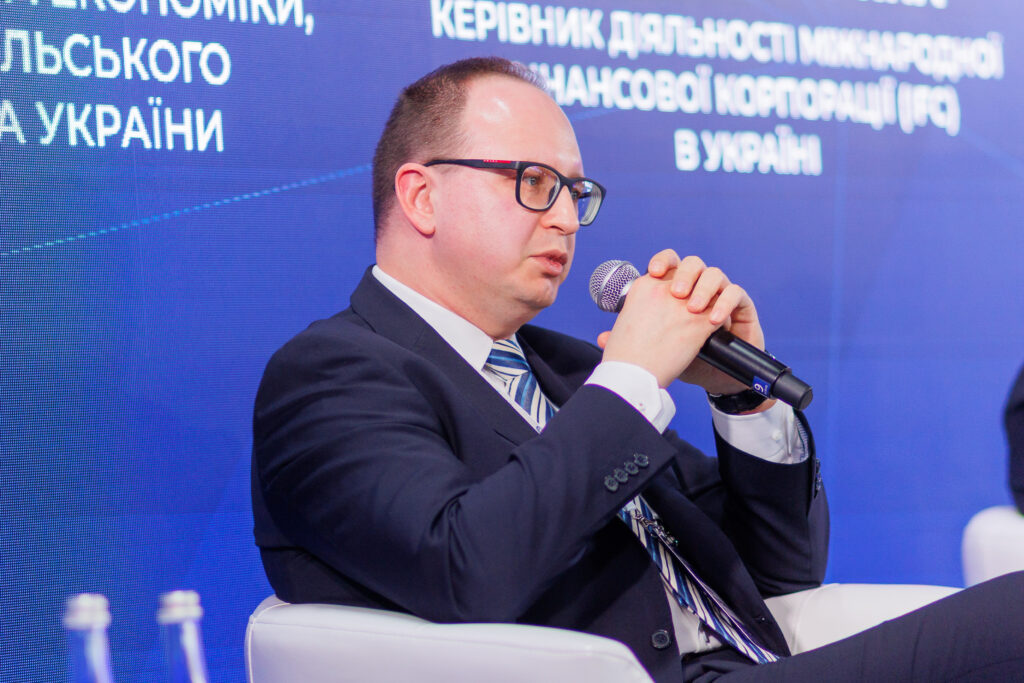
Yegor Perelygin, Deputy Minister of Economy, Environment, and Agriculture of Ukraine
The government views insurance as a key tool for mitigating risks and attracting investment in the process of Ukraine’s recovery.
The introduction of mechanisms for insuring war risks, market development, and the integration of international experience form the foundation for creating an investment-attractive economy and ensuring long-term growth.
In the context of post-war recovery, the state identifies the insurance market as a systemic element of risk management. The development of war risk insurance, increased penetration of insurance products, and the adaptation of international practices should ensure capital inflows, infrastructure protection, and the implementation of large-scale investment projects, noted Yegor Perelygin, Deputy Minister of Economy, Environment, and Agriculture of Ukraine, Yegor Perelygin, during a panel discussion at the Ukraine National Insurance Conference (UNIC), which took place in Kyiv on March 27 and was organized by the Federation of Insurance Associations of Ukraine.
Insurance is a unified ecosystem for risk mitigation
“Today, insurance is a unified ecosystem and entity that can operate under the brand or concept of risk mitigation. Why is this important? Because everything has become much more complex than it used to be,” says Yegor Perelygin.
Ukraine’s recovery requires hundreds of billions of dollars in investment, which is impossible without an effective insurance system. The state is already implementing tools to cover war risks and is developing a multi-tiered insurance market model aligned with international standards and aimed at attracting global partners.
We see that economic competition abroad—in other words, global markets and industrial development—increasingly depends on the ability of the state or quasi-state and quasi-sovereign instruments to deploy a sufficient number of insurance and risk mitigation mechanisms to stimulate Ukraine’s economic growth. This is now evident.
Competing is becoming more difficult. In this regard, the state understands how to mitigate risks to critical infrastructure, and I believe there is now sufficient momentum to create non-standard approaches and tools to stimulate the development of the insurance market, because we understand that the penetration rate of insurance products is too low for a country aspiring to a Western future and international integration. Second, the government must understand—and it does understand—that it needs to implement insurance programs that already provide the market and customers with the opportunity to see that there is a functioning mechanism for marketing insurance coverage.
And that is why, for example, the government has already introduced a mechanism for insuring against war risks, and there is an existing system for compensating businesses for losses. Could it be bigger, better, and more comprehensive? Well, surely it needs to grow. But you have to start somewhere, don’t you?
When the government decided to create, for example, the American-Ukrainian Fund for the Reconstruction of Ukraine, in which I was actively involved, the first question was what capital to start this project with and what coverage limits to set.

We believe that the war risk insurance system, which has been in effect since the beginning of the year, provides, more or less, the most important indicator and direction of where the state wants to go. Without insurance, it will be impossible to build an investment-attractive economy.
This is an absolute axiom. The state views the full spectrum of these insurance market instruments as a key element for implementing an adequate recovery program.
Why? Everyone has seen the estimates that Ukraine needs $588 billion to recover from war damages, particularly for capital investments. We also understand which sectors will play a leading role. These will be energy, infrastructure, major construction projects, processing, and metallurgical projects—but these will be capital-intensive projects.
Infrastructure projects require significant funding; they need long-term benchmarks and timeframes for their payback periods. Therefore, we understand that without insurance, it will be impossible to attract serious long-term investors to Ukraine. And this applies not only to international relations with investors.
The insurance market is a key element of Ukraine’s economic recovery. From war risks to large-scale investment projects, the state is shaping a new insurance ecosystem designed to protect businesses, develop infrastructure, and facilitate integration into global markets.
In our view, this pertains more specifically to compensation for property and construction risks, and these are other types of challenges the state must address now. We estimate that the state’s and the economy’s needs to implement the recovery program will amount to $5 billion annually in insurance, of which 2 billion UAH in insurance premiums will be for the energy sector alone.
Therefore, this is a rather significant challenge that we must address and for which we must develop an adequate model for insuring war risks. We believe that this applies not only to traditional types of corporate insurance but also to health insurance. In my opinion, the state needs to address this issue as part of developing its relationship with citizens and steer the insurance market toward normal, adequate development.
International insurance practices and adaptation plans in Ukraine
When it comes to international insurance practices and their adaptation in Ukraine, the government has several priorities. While last year was dominated by Ukraine’s agreement with the United States on mineral resources—known as the “Reconstruction Fund”—this year the government is striving to focus on identifying new opportunities for the insurance market in collaboration with the National Bank of Ukraine.
However, it is very important for us to engage a British pool of partners. We fully understand that the British market is of paramount importance to us. Therefore, we are already in discussions with major representatives of British business.
We have several ideas on how the state can build an adequate multi-tiered insurance market system together with the NBU, one that would function and be adapted to the needs of Ukraine’s frontline regions and, at the same time, to the needs of regions that are currently developing in terms of business relocation.
We also believe that one of our key success factors will be attracting international partners, insurers, and investors to our country. And, of course, if these programs are standard in the UK, we would certainly like to adapt these models for Ukraine.
Original source: https://forinsurer.com/public/26/03/27/5039